
A data report by Eyes Off Indiana. Data current as of July 2, 2026. All figures in this report are reproducible from public data; see Data and Methods and Data Availability below. This report is a companion to Indiana by the Numbers: A 50-State, 92-County Census of License Plate Surveillance, which presents the same network as a geographic snapshot.
Abstract
Our July 2026 census counted roughly 3,000 automated license plate reader (ALPR) cameras mapped in Indiana. This report asks how the state got there. Because every camera in the dataset is an OpenStreetMap object, each carries a full public edit history — so instead of relying on our own database, we reconstructed the timeline from the source: we retrieved the edit history behind all 3,046 ALPR cameras currently mapped in Indiana and dated each one to the moment it first entered the map, correcting for retagged objects. We supplemented this with time-travel queries against OpenStreetMap's historical database going back to 2019.
Three findings stand out:
- The documented network went from 1 camera to 3,046 in under four years — and most of that growth is recent: 107 cameras were on the map at the end of 2024, 1,815 at the end of 2025, and 3,046 today. Over the last twelve months the map added a camera roughly every 3.4 hours.
- Documented coverage spread from 3 counties to 84 of 92 in about twenty months. Sixty-three counties saw their first documented camera in 2025 alone.
- The curve measures documentation, not deployment — and that distinction cuts in one direction. Indianapolis alone had over 214 ALPRs running in September 2022, when the entire state map showed one camera. The map has been catching up to a network that was already there, which means every point on the curve is a floor. As the mapping community has matured (513 volunteers, with the top contributor now accounting for just 7% of new entries), the map has converged toward the real network — and it is still recording roughly 200 new cameras a month in 2026.
Key Findings at a Glance
| Measure | Value |
|---|---|
| Mapped ALPR cameras in Indiana, July 2, 2026 | 3,046 |
| First ALPR camera documented in Indiana | December 5, 2022 (Elkhart County) |
| Mapped cameras at end of 2024 | 107 |
| Mapped cameras at end of 2025 | 1,815 (17× growth in one year) |
| Added in first half of 2026 | +1,214 (+67%) |
| Average pace, last 12 months | 7.0 cameras per day — one every 3.4 hours |
| Biggest single month | November 2025 (+551) |
| Counties with documented cameras | 3 (Oct 2024) → 84 (today) |
| Distinct volunteer mappers | 513 |
| Cameras branded Flock Safety | 2,763 of 3,046 (90.7%) |
| One mapped camera per N residents | 64,713 (end 2024) → 2,273 (today) |
1. Background
Our companion census established where Indiana stands today: 9th among the 50 states in total mapped ALPR cameras and 6th per capita, with cameras documented in 84 of 92 counties. A snapshot, however, cannot answer the question legislators ask most often: how fast is this growing?
This report answers it with the most transparent instrument available. The dataset behind DeFlock.me — the volunteer project that documents ALPR locations nationwide — lives in OpenStreetMap, and OpenStreetMap keeps a complete, public, versioned history of every edit ever made. Every camera on the map carries a timestamp recording when a volunteer first documented it, and the database can be queried as it existed on any past date. No records request, no vendor disclosure, and no trust in this organization's own bookkeeping is required to verify any number below.
2. Data and Methods
Camera histories. On July 2, 2026 we retrieved every node tagged man_made=surveillance with surveillance:type=ALPR inside Indiana's administrative boundary from OpenStreetMap via the Overpass API — 3,046 nodes — including each node's version number, last-edit timestamp, and contributor. For the 2,589 nodes (85%) never edited since creation, the creation timestamp is definitive. For the 457 nodes edited after creation, we retrieved the full version history from the OpenStreetMap API and dated each camera to the earliest version carrying the ALPR tags — not the node's creation date, because mappers occasionally retag an existing pole or signal node when a camera is mounted on it. (Skipping this correction would backdate four cameras to as early as 2007.)
Historical cross-checks. The per-camera method yields a survivor curve: cameras on today's map, by the date they were first documented. It cannot see cameras that were mapped and later deleted. To confirm deletions do not distort the trend, we separately queried the Overpass API's historical ("attic") database for the total count of Indiana ALPR nodes as the map actually stood on each quarter-boundary since 2019. The two series agree within about 4% at every point (e.g., 111 cameras actually on the map on January 1, 2025, versus 107 on the survivor curve), so deletions are negligible and the survivor curve is used throughout.
National comparison series. Whole-US historical queries exceed the Overpass server's execution limits, so the national series in Figure 3 uses the same survivor-curve method applied to all 110,860 ALPR nodes in the continental US, restricted on both sides of the ratio to nodes unedited since creation (77% of US nodes, 85% of Indiana nodes) so that numerator and denominator are dated identically.
County assignment. Each camera was assigned to a county by point-in-polygon test against US Census Bureau county boundaries, as in the companion census.
What the dates measure. A camera's date in this report is the date a volunteer first documented it — an upper bound on its installation date, never a lower one. Section 4 addresses the resulting interpretation question directly.
3. The Timeline
Indiana's first mapped ALPR camera was documented in Elkhart County on December 5, 2022. For nearly two years it was almost alone: on July 1, 2024, the state map showed six cameras. Then the documentation wave arrived — DeFlock launched in mid-2024 and gave the public both a reason and a tool to map these devices — and the curve turned vertical.
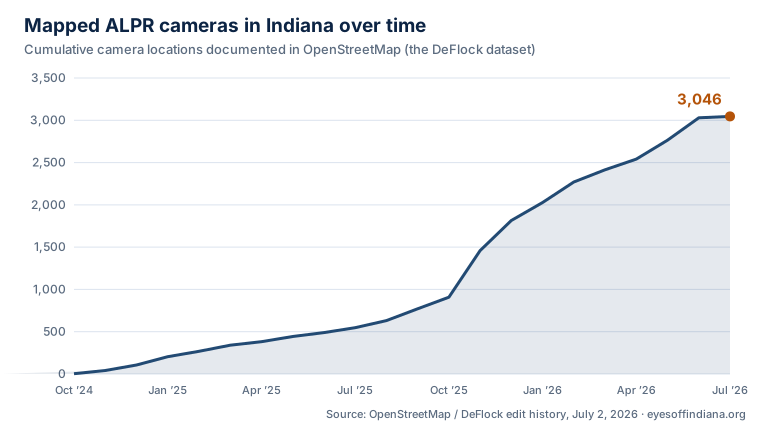
Table 1. Time for the documented network to add each 500 cameras
| Milestone | Date reached | Time from previous |
|---|---|---|
| 1st camera | Dec 5, 2022 | — |
| 500 | Jul 5, 2025 | 2 years 7 months |
| 1,000 | Nov 9, 2025 | 127 days |
| 1,500 | Dec 3, 2025 | 24 days |
| 2,000 | Jan 24, 2026 | 52 days |
| 2,500 | Apr 24, 2026 | 90 days |
| 3,000 | Jun 28, 2026 | 65 days |
The first 500 cameras took two and a half years to document. The step from 1,000 to 1,500 took twenty-four days. And the pace has not burned out: after the November–December 2025 surge, the map settled into a sustained 2026 rhythm of roughly 200 new cameras a month — the second quarter of 2026 (614 added) outpaced the first (600).
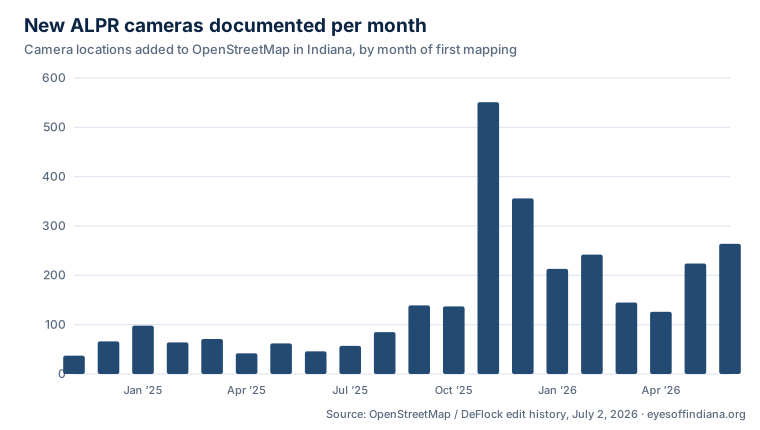
In per-capita terms: at the end of 2024, Indiana had one mapped camera per 64,713 residents. Today it has one per 2,273.
4. Mapping Effort or Camera Growth? Reading the Curve Honestly
These cameras are documented by volunteers, so part of Figure 1's slope reflects growth in documentation, not growth in cameras. We believe the honest reading is neither "the network doubled in six months" nor "this is just mapping enthusiasm." Four pieces of evidence bound the interpretation.
The network predates the map — so every point on the curve is a floor. Indianapolis's police department alone had 214 ALPRs running by September 2022 and more than 250 by early 2023, under a $6 million contract covering 400 leased cameras. On the day IMPD announced those 214 cameras, the OpenStreetMap count for the entire state of Indiana was zero. The steep 2024–2025 segment of the curve is therefore substantially catch-up: volunteers documenting a network that had been built, quietly, in the preceding years. That is not a weakness of the data — it is the finding. A surveillance network of this size operated for years before the public could see it on any map.
The mapping community has decentralized as it grew. If the curve were an artifact of a few enthusiasts, the work would be concentrated. It is the opposite: concentration has fallen steadily as volume grew.
Table 2. Concentration of mapping activity over time (among the 85% of cameras attributable to a specific documenting volunteer)
| Period | Cameras documented | Distinct mappers | Top mapper's share | Top-5 share |
|---|---|---|---|---|
| Through Jun 2025 | 352 | 30 | 19% | 58% |
| Jul–Dec 2025 | 1,128 | 190 | 12% | 33% |
| Jan–Jul 2026 | 1,109 | 359 | 7% | 16% |
In 2026, 359 different people documented cameras in Indiana, and no individual accounted for even a tenth of them. This is what a map converging on ground truth looks like — many independent observers reporting the same infrastructure.
Nationally, the map has caught up with the vendor's own numbers. Flock Safety — which manufactures 90.7% of Indiana's mapped cameras — reported nearly 90,000 cameras nationwide as of July 2025 and crossed 100,000 in mid-2026. OpenStreetMap now records 110,198 ALPR cameras across all vendors in the US. When DeFlock launched in July 2024, the national map held about 1,700 US cameras; it now documents a total on par with what the dominant vendor says it has deployed. The catch-up phase, in other words, is largely over — which means ongoing additions increasingly reflect newly deployed cameras rather than newly discovered old ones.
Indiana's share of the national map has climbed past its share of the national population. If Indiana's curve merely tracked national mapping enthusiasm, its share of the US total would be flat. It is not: comparing first-documented dates on both sides of the ratio, Indiana held about 0.7% of the nation's mapped cameras in mid-2024 and 1.6% at the start of 2025, crossed its 2.0% share of the US population during the first half of 2025, and holds about 3.0% today (2.8% of the full national dataset). Indiana's map did not just grow with the country's; it outgrew it.
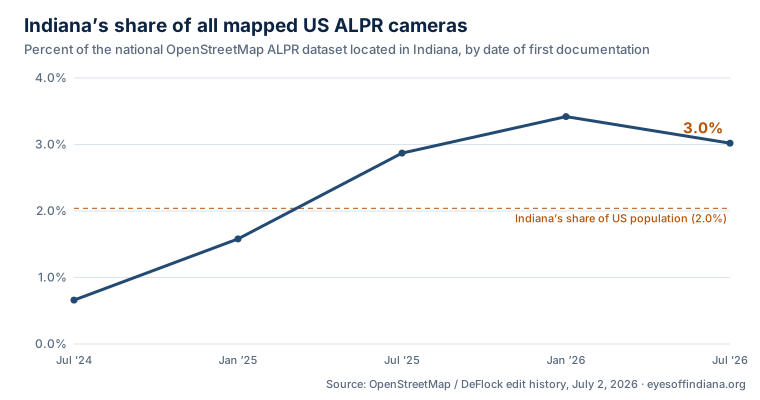
Taken together: the early curve is dominated by documentation catching up to reality, the 2026 curve is a mature map tracking a still-expanding network, and at no point does the map overstate what exists on Indiana's roads.
5. The County Spread
In October 2024, documented ALPR cameras existed in three Indiana counties. Today they exist in 84.
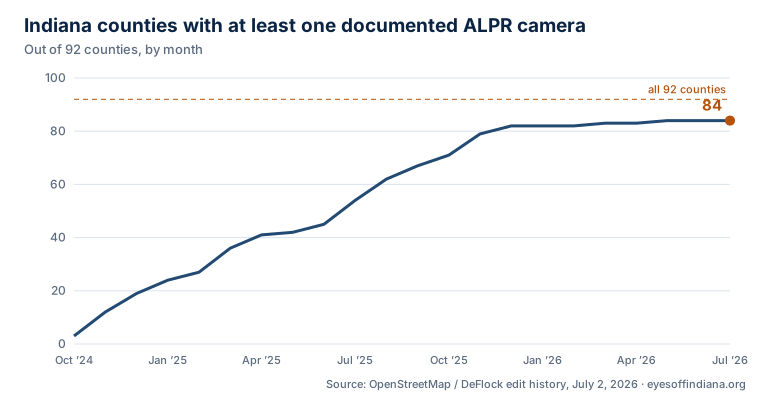
Growth in 2026 is not confined to the map's frontier — it is deepest in the counties that already had the most cameras:
Table 3. Indiana counties by cameras documented in 2026 (through July 2)
| County | Added in 2026 | Total today | First camera documented |
|---|---|---|---|
| Marion | +170 | 509 | Nov 2024 |
| Lake | +158 | 205 | Dec 2024 |
| Hamilton | +66 | 213 | Aug 2023 |
| Hendricks | +58 | 110 | Dec 2024 |
| St. Joseph | +55 | 111 | Feb 2025 |
| Allen | +52 | 117 | Apr 2025 |
| Clark | +47 | 104 | Nov 2024 |
| Vanderburgh | +42 | 108 | Nov 2024 |
| Madison | +40 | 77 | Dec 2024 |
| Elkhart | +38 | 101 | Dec 2022 |
Lake County is the clearest acceleration story in the state: more than three-quarters of its 205 documented cameras were added to the map in 2026.
6. Discussion
The public map of this network is barely two years old — and the network it reveals is far older. The single most important date in this report may be the one where the curve sits at zero: September 2022, when Indianapolis announced 214 operating ALPRs and not one appeared on any public map. Whatever fraction of the recent curve is catch-up documentation, that fraction is itself the policy problem — Hoosiers spent years being scanned by infrastructure no one could see.
The growth is current, sustained, and statewide. This is not a completed buildout being belatedly recorded. With the catch-up phase largely over, the map still gained 1,214 cameras in the first half of 2026 — about 200 a month, quarter over quarter, spread across the state's largest counties. Nationally, the vendor's own trajectory (90,000 cameras in mid-2025, 100,000+ a year later) corroborates a network that is still expanding, even as dozens of localities nationwide have begun canceling contracts.
Every number in the debate should be treated as a minimum. The consistent lesson of the timeline is that reality has always been ahead of the map. Legislators weighing retention limits, access rules, and audit requirements should assume the network is larger than 3,046 cameras today, and larger still by the time any bill takes effect.
7. Limitations
- Documentation dates are upper bounds on installation dates. Most cameras in this dataset were installed before the date shown; none were installed after. Growth rates computed from the steep 2024–2025 segment overstate deployment speed for that period, which is why this report's deployment claims rest on the mature-map 2026 segment and on external anchors, not on the catch-up wave.
- The survivor curve excludes cameras mapped and later deleted. Attic-database cross-checks bound this effect at roughly 4% at any point in the series.
- Contributor statistics cover the 85% of cameras whose current version is the original. Table 2 conservatively uses only these unambiguous attributions. Figure 3's national comparison is restricted to the same never-edited subset on both sides of the ratio; the full-dataset endpoint (2.8%) differs from the subset endpoint (3.0%) by 0.2 points, indicating the restriction does not drive the trend.
- All counts are floors. Volunteer coverage is incomplete, especially in rural counties; DeFlock's own verification efforts suggest true camera counts exceed mapped counts in most places.
Appendix. Month-by-month timeline
| Month | Cameras added | Cumulative total | Counties with cameras |
|---|---|---|---|
| Pre-Oct 2024 | 4 | 4 | 3 |
| Nov 2024 | 37 | 41 | 12 |
| Dec 2024 | 66 | 107 | 19 |
| Jan 2025 | 98 | 205 | 24 |
| Feb 2025 | 64 | 269 | 27 |
| Mar 2025 | 71 | 340 | 36 |
| Apr 2025 | 42 | 382 | 41 |
| May 2025 | 62 | 444 | 42 |
| Jun 2025 | 46 | 490 | 45 |
| Jul 2025 | 57 | 547 | 54 |
| Aug 2025 | 85 | 632 | 62 |
| Sep 2025 | 139 | 771 | 67 |
| Oct 2025 | 137 | 908 | 71 |
| Nov 2025 | 551 | 1,459 | 79 |
| Dec 2025 | 356 | 1,815 | 82 |
| Jan 2026 | 213 | 2,028 | 82 |
| Feb 2026 | 242 | 2,270 | 82 |
| Mar 2026 | 145 | 2,415 | 83 |
| Apr 2026 | 126 | 2,541 | 83 |
| May 2026 | 224 | 2,765 | 84 |
| Jun 2026 | 264 | 3,029 | 84 |
| Jul 2026* | 17 | 3,046 | 84 |
*Partial month: July 1–2, 2026.
Data Availability
Camera locations and edit histories: OpenStreetMap contributors, retrieved via the Overpass API and the OpenStreetMap API v0.6 (query: man_made=surveillance and surveillance:type=ALPR), July 2, 2026, © OpenStreetMap contributors, ODbL. Historical counts: Overpass API attic queries ([date:...]). The same data may be explored interactively at DeFlock.me. County boundaries: US Census Bureau cartographic boundary files. The per-camera dataset (first-documented date, county, contributor metadata), the monthly series, and all retrieval and analysis scripts are available from Eyes Off Indiana on request.
Suggested Citation
Eyes Off Indiana. Indiana Over Time: The Documented Growth of License Plate Surveillance, 2022–2026. July 2, 2026. https://eyesoffindiana.org/articles/indiana-alpr-surveillance-growth-over-time
A network that took four years to build became visible to the public only in the last twenty months — and it is still adding roughly 200 documented cameras a month, under no statewide rules for retention, access, or oversight. If you believe growth like this deserves guardrails, sign the Eyes Off Indiana petition and contact your state representative.